Disclosure before anything else. Restore Health does not offer exosome injections, infusions, or exosome-based procedures of any kind. I have nothing to gain from what follows, in either direction.
I am writing this because exosomes are now sold in medical spas, wellness clinics, IV lounges, and hair restoration practices across Fairfield County and everywhere else, and the sales pitch is unusually good. It cites real journals. It uses real vocabulary. Parts of it are entirely true, which is what makes the rest so hard to evaluate. Most patient-facing writing on this subject fails in one of two directions: it either repeats clinic marketing with a scientific accent, or it dismisses the whole field as fraud. The second approach is wrong on the facts and easy to discount, and neither helps you decide anything.
There is a real line between what is established and what is not. It just falls somewhere most people would not guess. It is not the line between “exosomes work” and “exosomes don’t.” It is the line between a characterized product tested under supervision and an uncharacterized product sold by the billion. Those two things can contain physically similar material and still be completely different propositions.
Here is the summary, and the rest of this article will earn it. The biology is real. One diagnostic application is validated and sits in national guidelines today. Therapeutic development is real, ongoing, and in a few cases genuinely impressive. But the retail market has run years ahead of validated product identity, potency, efficacy, long-term safety, and lawful regulatory status, and that gap is not narrow.
Contents
Part 1 – What an exosome is · What they do · How this differs from a hormone · Why the label tells you almost nothing Part 2 – Where the material comes from · What is actually in the vial · Why “dose” is not a dose Part 3 – The established use: diagnosis Part 4 – What is genuinely promising Part 5 – The grey zone Part 6 – What is being sold, and how Part 7 – Harms on record Part 8 – The rules, in plain English Part 9 – What to ask before you pay
Part 1: What an exosome actually is
Nearly every cell in your body releases tiny sealed packets into the fluid around it. Each one is wrapped in the same material the cell membrane is made of, a lipid bilayer (a double sheet of fat molecules curved into a closed bubble), and inside it and studded through its wall are proteins, fats, and several kinds of RNA. The umbrella term for all of these packets is extracellular vesicle, usually shortened to EV. Extracellular means outside the cell, and a vesicle is a small fluid-filled sac. That is all it is: a small sac outside the cell.
An exosome is one particular type of EV, and here is the detail that matters more than any other in this article: it is defined by how it was made, not by what it looks like.
The sequence has four steps. First, the cell pulls a patch of its own outer membrane inward, the way you would press a thumb into the surface of a balloon. The pocket deepens and pinches off, becoming a sealed compartment floating inside the cell, called an endosome. Second, the wall of that compartment buds inward again, dozens of times over, and each little bud pinches off into the interior of the compartment. As it does, the cell packs specific molecules into it. This is the step that matters most, because cargo is not swept in at random; the cell uses dedicated machinery to select what goes in. Third, the compartment is now full of small vesicles, a bag of bubbles, and at this point it earns its formal name, multivesicular body. Fourth, the bag travels to the cell surface, fuses with it, and opens outward like a pouch turned inside out, releasing the bubbles that were inside into the fluid around the cell. Those released bubbles are exosomes.
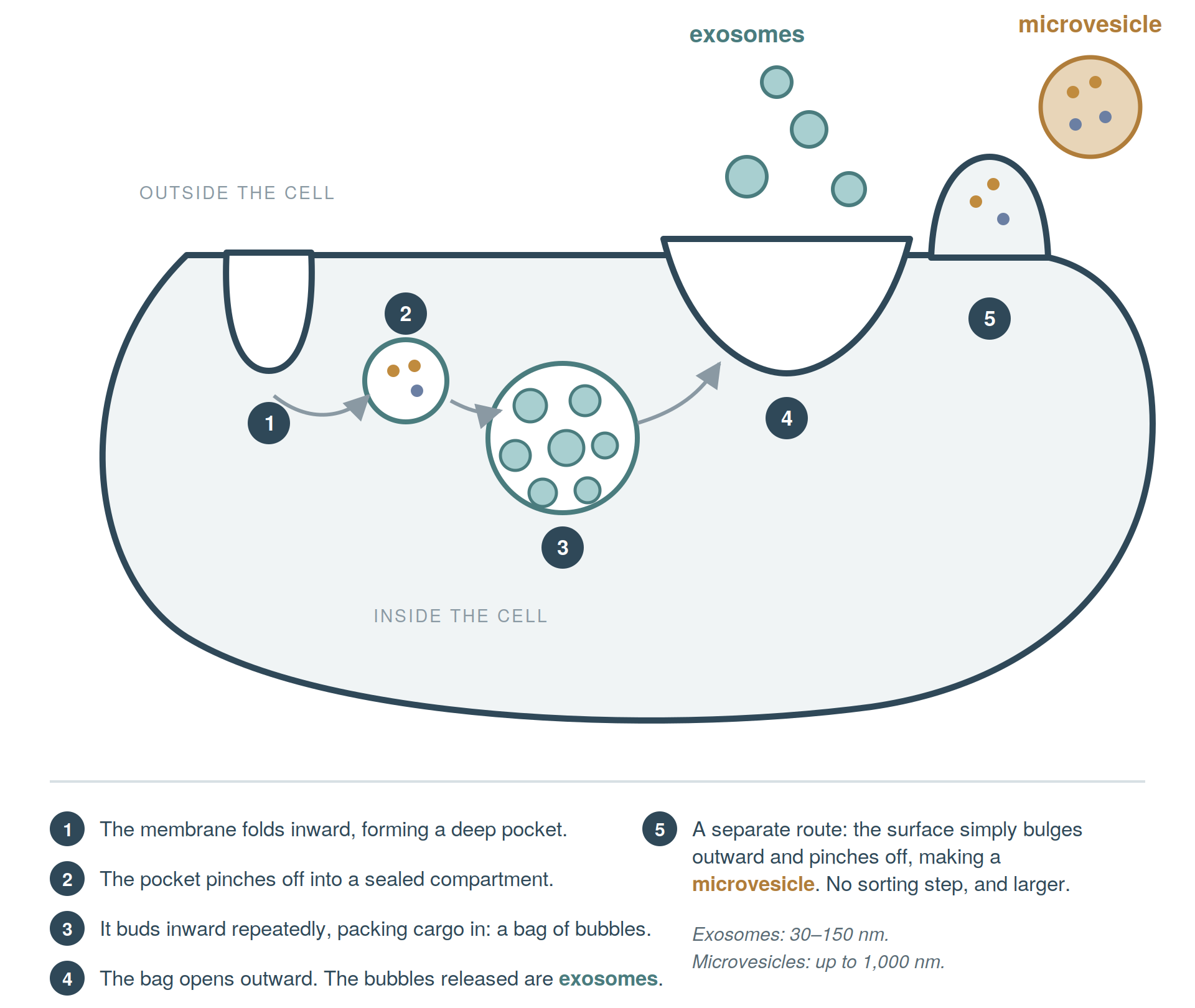
Cells also release vesicles a second way, and it is much simpler. A patch of the outer membrane bulges outward, the neck of the bulge narrows, and it pinches off. One step. No internal compartment, no sorting machinery, no bag of bubbles. That is stage 5 in the diagram above, on the right side of the cell. These are microvesicles, sometimes called ectosomes, and they are also bigger: up to 1,000 nanometers, against 30 to 150 for exosomes. For scale, a human red blood cell is about 7,000 nanometers across, so you could line up fifty exosomes side by side and still not span one red cell. Separately, dying cells break apart and shed larger fragments called apoptotic bodies.
Notice what differs between the two routes. An exosome’s cargo was deliberately selected and packed during the inward-budding step. A microvesicle encloses whatever happened to be sitting at that patch of membrane when it bulged. Same cell, same raw materials, and in principle a different package. Hold onto that difference, because it becomes the whole story shortly.
What they do
For decades these vesicles were regarded as cellular waste disposal, a way for a cell to throw out unwanted membrane and protein. That view collapsed in 2007, when a Swedish group showed that vesicles carry RNA from one cell to another and that the delivered RNA can be read and translated into protein by the receiving cell. They were not garbage bags. They were mail.
The current understanding is that EVs are a genuine channel of cell-to-cell communication, a way for one cell to send a package of molecular instructions to another, including cells far away, by traveling through blood or lymph. The cargo includes proteins, lipids, messenger RNA (the working copy of a gene’s instructions), microRNA (short fragments that switch other genes off), and some DNA. EVs have since been implicated in immune signaling, wound healing, tissue repair, formation of new blood vessels, bone remodeling, nerve signaling, and the process by which a tumor prepares distant tissue to receive metastases before any cancer cell arrives there.
That last item deserves flagging early. The same property that makes EVs interesting as a medicine, namely that they carry instructions between distant cells, is also a mechanism of cancer spread. That is not a reason for alarm. It is a reason that “these are natural, so they are safe” is not an argument.
Four properties make EVs genuinely attractive as a drug platform, and all four are legitimate. They contain no living cells, so nothing can grow in the wrong place or form a tumor from the transplanted material itself, which is a real advantage over stem cell therapy and the honest core of the “safer than stem cells” claim. They can be frozen, shipped, and stored, which is enormously more practical than a living cell therapy requiring a matched donor and an unbroken cold chain. There is evidence they can cross the blood-brain barrier, the tightly sealed vessel lining that keeps most drugs out of the brain and that remains the hardest problem in neurological medicine. And they can be loaded deliberately: you can engineer the producing cell to package a chosen cargo, a drug or a gene-silencing RNA, into the vesicles it releases. In my view that last one is the most promising application in the entire field, and it gets the least attention in consumer marketing, because it has nothing to do with wellness.
None of that is hype. All of it justifies serious research funding. And none of it is evidence that any particular vial does anything at all.
How this differs from a hormone
If exosomes sound familiar, it is because your body already runs a signaling system you have heard of. Hormones are chemical messengers, released by one tissue, carried in the blood, acting on cells somewhere else entirely. Thyroid hormone leaves the thyroid and changes metabolism throughout the body. Insulin leaves the pancreas and tells muscle and liver what to do with glucose. So the comparison is fair, and it is the fastest way to understand what extracellular vesicles are for. Both systems are the body’s mail service.
It is also the comparison that makes the rest of this article make sense, because of where the two part company. There are five differences, and every one of them matters commercially.
A hormone is a single defined molecule. Thyroxine has one chemical structure, and it is the same molecule in you, in a laboratory in Basel, and in a tablet manufactured in 1975. An exosome preparation is not a molecule at all. It is a population of millions of particles, each carrying hundreds or thousands of different proteins, lipids, and RNA fragments, in proportions that vary from batch to batch. A hormone also has a known receptor, a specific lock on a specific cell type, which is why its effects are traceable and predictable; how vesicles get taken up by recipient cells, and which cells take them up, is still incompletely understood, with the research literature describing several possible routes and not fully agreeing on which dominates.
A hormone can be measured in a patient. We draw blood and report a number. There is no test that tells you how much exosome activity is circulating in a person, before or after treatment, so there is nothing to check and nothing to titrate against. A hormone dose is a mass of a pure substance: 88 micrograms of levothyroxine means the same thing everywhere on earth, because the number refers to a defined quantity of one known molecule. There is no equivalent unit for exosomes, and we will come back to that shortly, because it explains a peculiarity in how even the best clinical trials describe their dosing. Finally, a hormone is manufactured to a pharmacopeial standard, with purity and identity verified against a published specification. Exosomes are harvested from living cell cultures, so the product depends on which cells, which growth conditions, and which purification method, and the specification, if one exists at all, is the manufacturer’s own.
The analogy is genuinely useful for grasping what these particles do in the body. It becomes misleading the moment it is used to suggest they can be dosed, measured, and administered the way a hormone can. They cannot, and that is not a temporary gap in the technology.
Why the word “exosome” on a label tells you almost nothing
An exosome is defined by the route it took out of the cell, but the finished vesicle carries no record of that journey. Once it is floating in fluid you are looking at a small sealed bubble, and you cannot rewind it.
There are three separate reasons the two types cannot be separated after the fact. Their sizes overlap: exosomes run roughly 30 to 150 nanometers and microvesicles run roughly 100 to 1,000, so in the overlap zone size tells you nothing, and lipoproteins (the ordinary cholesterol-carrying particles present in any blood-derived material) sit in the same range too. Their surface markers overlap: the proteins most often cited as evidence that a preparation contains exosomes are a family called tetraspanins, particularly CD9, CD63, and CD81, and while these are genuinely enriched on exosomes they are also present on microvesicles, so detecting them narrows things down without settling anything. And the purification methods cannot separate them either, because every technique used to concentrate vesicles out of fluid (spinning, filtering, precipitating, running through a sizing column) works on physical properties like size and density, which the two types share. Every method collects both, along with anything else of similar size.
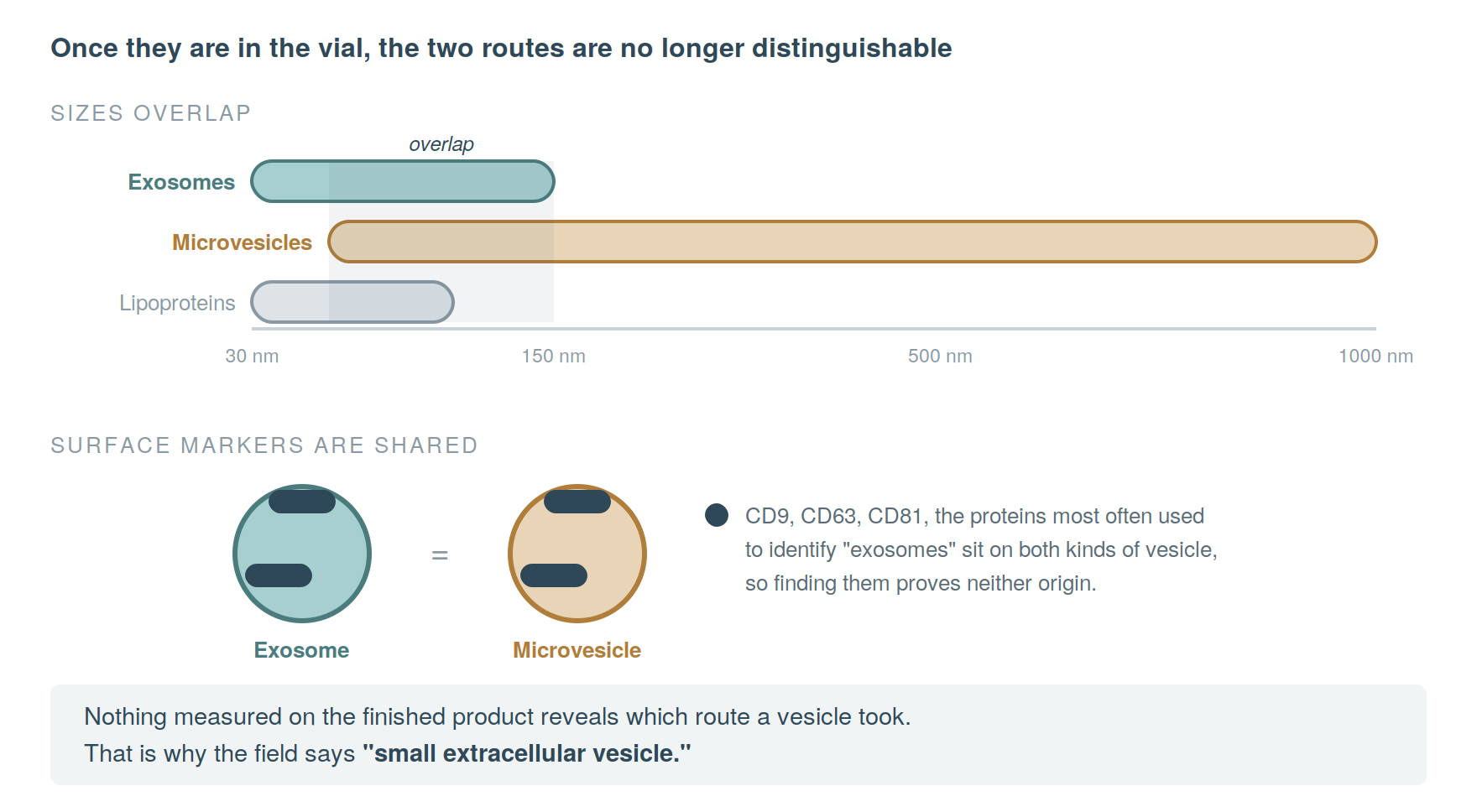
Faced with a field where thousands of papers claimed to study “exosomes” without being able to show they had any, the International Society for Extracellular Vesicles wrote a standards document. It is called MISEV, for Minimal Information for Studies of Extracellular Vesicles, and it has been revised three times, most recently in 2023. MISEV is not a law and not a regulation. It is a consensus agreement among researchers about what you have to report for your results to be interpretable by anyone else. In broad terms it asks scientists to name vesicles by what was measured rather than what is assumed (if you separated by size and got small vesicles, call them small extracellular vesicles, and reserve “exosome” for cases where the biogenesis route was actually demonstrated, which usually means watching it happen in living cells rather than examining the end product), to report the separation method in full because the method determines what you collected, to characterize with multiple markers including checking for the contaminants you would expect, and to report purity rather than just quantity: how much protein came along per particle, and whether batches match each other.
Adherence is imperfect even in the research literature. A 2026 review of this field noted that characterization practices rely on inconsistent parameters with variable adherence to MISEV, and that particle-to-protein ratio and batch-to-batch consistency are frequently underreported. (Review)
It would be reasonable to read all of this as academic hair-splitting. It is not, and here is why. Go back to the diagram. Exosome cargo is selected and packed by dedicated cellular machinery during the inward-budding step, while microvesicle cargo is whatever was at that patch of membrane at that moment. If the therapeutic effect of these vesicles comes from what they carry, which is the entire premise, then two vesicles that took different routes are two different drugs even though they came from the same cell and look identical. The same logic applies twice more. A vesicle from a bone-marrow stromal cell and a vesicle from placental tissue carry different payloads, because the cargo reflects the cell that made it, and both get labeled “exosomes.” Two manufacturers starting from the same cells but using different purification methods end up with different proportions of vesicle types and different amounts of non-vesicle debris, and both get labeled “exosomes.”
Stack those three and the word on the label is compatible with an enormous range of actual contents. That produces three concrete consequences. The first is that evidence cannot transfer between products, which is the mechanism behind a marketing move you will meet later in this article: a clinic cites a published study as support for what is in its vial, but if the study used well-characterized bone-marrow-derived small EVs isolated by chromatography and the vial holds a placental extract of unknown composition, the study is not evidence about the vial. The shared word is doing all the work. The second is that the research literature itself is hard to compare, which is why systematic reviews of exosome therapy keep reaching the same verdict of heterogeneous, low certainty, needs standardization. It is not that researchers are careless. It is that studies of non-identical products cannot be meaningfully pooled, so evidence accumulates without ever converging. The third is that there can be no potency test without a defined product. A potency assay measures how much biological activity a batch has, and you cannot build one until you know what the active ingredient is and can confirm each batch contains it. So the missing potency assay described in Part 2 is not an oversight anyone could fix by trying harder. It follows directly from the identity problem described here.
The practical upshot for a patient is this. On a product label, “exosomes” is a marketing category, not a verified description of contents. A rigorous study of well-characterized bone-marrow-derived small EVs does not validate a vial of placental extract labeled “exosomes,” any more than a trial of amoxicillin validates a bottle labeled “antibiotic.” So the question to ask a provider is not “are these exosomes,” because nobody selling them can answer that and the confident ones are the least reliable. The question is: what was this product measured to contain, and by what method? That either has an answer or it conspicuously does not.
Part 2: Why this is harder than it looks
Most articles about exosomes skip manufacturing. It is the part that decides everything, because it is where a real product and an expensive unknown become different objects.
Products sold as exosomes come from at least five very different origins, and the differences are not cosmetic. Cultured mesenchymal stromal cells (MSCs, the connective-tissue stem cells obtained from bone marrow, fat, umbilical cord tissue, or dental pulp) are grown in a laboratory and the vesicles they secrete are collected and concentrated. This is the source used by every serious clinical program, and it is also the most expensive and technically demanding, which is precisely why it is not what most of the retail market uses. Placental and amniotic tissue, meaning tissue left after birth, is processed into a liquid or freeze-dried powder and frequently marketed as an exosome product; what it generally is, is a mixed tissue extract that contains vesicles alongside a great deal of other material. This category is heavily represented in the clinic market and is the source implicated in the most serious documented safety incident in the United States. Platelet-derived vesicles are sometimes offered alongside or within platelet-rich plasma. Preparations from plants and fungi (rose stem cells, ginger, grapefruit, seaweed, medicinal mushrooms) constitute a legitimate research area, but note the term used in the actual literature: exosome-like nanovesicles. Plants do not have the same vesicle-forming machinery animals do, so these are structurally analogous particles rather than exosomes in the technical sense, and marketing routinely drops the “-like.” Finally there are bovine milk vesicles, mostly in supplements and cosmetics. These five are not interchangeable, do not carry equivalent risk, and do not share an evidence base, and they are all sold under one word.
What is actually in the vial
Here is a technical detail with consequences far beyond its obscurity. Growing human cells in a laboratory normally requires adding fetal bovine serum, the liquid fraction of calf blood, to the culture fluid, because cells need growth factors to survive and divide. Calf blood contains enormous quantities of cow extracellular vesicles, and those cow vesicles end up mixed with the human vesicles you are trying to harvest. Manufacturers address this with “EV-depleted” serum, and it works poorly. In one study using both particle counting and a cow-specific antibody assay, commercially available exosome-depleted serum still contained roughly 5 × 10⁷ bovine vesicles per millilitre, and worse, the depletion process actually enriched the small-vesicle fraction, raising small EVs from 48% of total particles before depletion to 92% after. Even at the lowest serum concentrations used in culture this produced meaningful contamination of the human preparation. (Study) A separate line of work found the same problem for RNA: cow-derived RNA survives depletion, co-purifies with the human material, and can be misannotated as human, and several microRNAs previously reported as enriched in cell-derived vesicles appear to have been calf serum all along. (Study)
Sit with that for a second. In a field whose entire premise is that these vesicles carry a meaningful molecular message, some portion of the published message may have come from the cow. Careful laboratories now run media-only controls specifically to catch it. Whether commercial manufacturers do is unknown, because they do not publish.
The separation method matters just as much. There are four common approaches: ultracentrifugation (spinning at extreme speed until vesicles pellet, which also pellets protein clumps), polymer precipitation kits (cheap, fast, and notorious for dragging down large amounts of non-vesicle protein), size-exclusion chromatography (passing fluid through a column that separates particles by size, cleaner but lower yield), and tangential flow filtration (scalable, favored for manufacturing). Two preparations made from the same cells by two of these methods are different products with different contents and different purity, and no industry standard requires anyone to tell you which was used.
Then there is the measurement problem, which is where this becomes concrete for a patient. Clinics price exosomes by particle count: 20 billion, 60 billion, 100 billion. That figure almost always comes from nanoparticle tracking analysis, an instrument that shines a laser through the sample and infers particle size and number from how particles scatter light and jiggle in fluid. The instrument counts everything in the size range. Lipoproteins are the same size. So are protein aggregates. So are the cow vesicles from two paragraphs ago. So is casein, the main protein in milk. Nanoparticle tracking cannot distinguish any of them from an exosome. So “60 billion exosomes” means precisely this: sixty billion objects of approximately the right size were detected. It is not a count of exosomes, it is not a measure of biological activity, and it is the number that sets the price. Careful research groups report a particle-to-protein ratio as a crude purity check, since a great deal of protein per particle suggests you are mostly selling debris. That figure is essentially never disclosed commercially.
Which brings us to potency. In pharmaceutical terms, potency means a measured biological effect tied to the label: this quantity of material produces this much activity, verified for every batch before release. There is no accepted potency assay for exosome products. Not a poor one. None. Two vials from one manufacturer with identical particle counts can carry different cargo, and vials from different manufacturers are not comparable on any axis.
Why “dose” is not a dose
Look at how the serious trials handle this, because it is revealing. The Phase 3 trial of an investigational product for lung failure specifies its dose as up to three intravenous doses of 15 millilitres. Fifteen millilitres is a volume, about three teaspoons of liquid. It is not a dose in the sense the word normally carries in medicine. Compare it to levothyroxine, where 88 micrograms is a quantity of a specific molecule, so the number tells you how much active substance the patient received. “Fifteen millilitres” tells you only how much fluid went into the vein, and how much active material was in that fluid depends entirely on what that company’s preparation contains. It can be compared only to another 15 millilitres of the identical product from the identical process.
That is not sloppiness on the sponsor’s part. It is the only honest option available, because you cannot state a dose in units of active substance when nobody has established what the active substance is or how to quantify it. So the protocol specifies the one thing that can be controlled and reproduced: a fixed volume of a defined manufacturing process. The other way around the problem is experimental. The pancreatic cancer trial at MD Anderson never had to name a meaningful unit either, because it used a formal dose-escalation design, giving the product on days 1, 4, and 10 of a 14-day cycle and stepping the amount upward in successive small groups of patients until toxicity appeared, which establishes a maximum tolerated dose for that specific product without requiring any universal unit.
Notice what neither trial does. Neither expresses dose in billions of particles. Not because the sponsors lack particle-counting equipment, since they have it, but because across different products a particle count would not mean anything. That is the whole point. The most rigorous programs in the field work around the missing unit. The retail market invented one and printed it on a price list.
There is a related form of fabrication worth naming here. I have read clinic pages asserting that published pharmacokinetic data, meaning measurements of how a drug is absorbed, distributed, and cleared, guide their loading and maintenance schedules, and that studies demonstrate diminishing returns above a stated particle count. No such data exist. The schedules were invented, and invented in a register that sounds like pharmacology. If you are shown one, ask for the citation and then go look it up.
One last item belongs in this section. An injectable biological product requires, at bare minimum, verified sterility, endotoxin testing (endotoxins are fragments of bacterial cell wall that cause fever and shock even when no living bacteria remain), mycoplasma testing (a bacterial contaminant common in cell culture and invisible on standard sterility tests), donor screening for transmissible infection, identity and purity testing on every lot, and validated stability data for the storage conditions actually used. A licensed product demonstrates all of this to a regulator before sale. An unapproved product demonstrates it to nobody. Freeze-dried products raise a further question, which is what liquid is used to reconstitute them, by whom, and under what conditions.
Part 3: What is established
The most mature clinical application of exosome science is a diagnostic test, not a treatment, and it is worth understanding in some detail because it demonstrates what established actually looks like.
The ExoDx Prostate IntelliScore is a urine test measuring three genes (ERG, PCA3, and SPDEF) carried in exosomal RNA shed from prostate tissue. Its intended population is men aged 50 and over with a PSA between 2 and 10 who are deciding whether to undergo a first biopsy, or who have had a negative biopsy and remain a clinical concern. In a pooled analysis of 1,212 men undergoing initial biopsy, the test produced an AUC of 0.70 for distinguishing clinically significant cancer from indolent disease and benign tissue, against 0.56 for PSA alone. AUC stands for area under the curve and measures how well a test separates two groups, where 0.5 is a coin flip and 1.0 is perfect. At its validated cutoff the test would have avoided 23% of all biopsies and 30% of the biopsies that turned out to be unnecessary, with a negative predictive value of 90%, meaning that of the men told they were low risk, 90% genuinely were. (Validation analysis · Decision-impact follow-up) The NCCN, whose guidelines American oncologists and insurers follow, lists it as an option to consider before biopsy. It is not a general screening test, it is not mandatory, and it is not first-line. But it is in the algorithm, which is more than any exosome therapy can claim. If you are weighing PSA decisions, that is covered in our men’s health section.
A second application is gaining ground. Tumor DNA in blood comes largely from dying cells, while living tumor cells actively release vesicles, so combining exosomal RNA with circulating tumor DNA improves detection of rare mutations. In lung cancer, combining the two increased detection of EGFR mutations roughly tenfold in one analysis. (College of American Pathologists overview) The broader biomarker literature, meaning microRNA panels for early detection of lung, breast, colorectal, and kidney cancer, remains at the research stage, and the obstacle is exactly the standardization problem from Part 2: results do not transfer between laboratories using different isolation methods.
Why did diagnostics cross the line first? This is the structural insight and it explains the shape of the whole field. A diagnostic test needs one thing, a reproducible signal. You measure something, show it correlates with an outcome, and validate that correlation prospectively in the population you intend to use it in. You do not need a controlled dose. You do not need sterility. You do not need to know the mechanism. You do not need to prove you changed anyone’s biology, because you did not, you only measured it. A therapy needs all of that plus proof it improves outcomes plus a manufacturing process reproducible enough that the thing tested in the trial is the thing in the vial three years later. That is an enormous difference in difficulty, and it is why one side of this field is in practice and the other is not.
Part 4: What is genuinely promising
The most scientifically impressive work in this field is also the least marketed, because it has nothing to do with wellness. Investigators at MD Anderson engineered exosomes from bone-marrow stromal cells to carry a silencing RNA targeting KRAS G12D, a mutation that drives a large share of pancreatic cancers and that has resisted conventional drug design for forty years. After preclinical work in mice and macaques, the iEXPLORE trial treated patients with metastatic pancreatic cancer who had already failed multiple lines of therapy, and results published in Nature Communications in September 2025 reported no dose-limiting toxicity, evidence the drug engaged its target, and measurable reprogramming of the tumor’s immune environment. (Published trial) This is a Phase 1 safety study in refractory cancer, not a cure, and it should not be described as one. What it demonstrates is the thing worth being excited about: exosomes as a delivery vehicle for a precisely specified cargo, manufactured under pharmaceutical conditions, tested under regulatory supervision, with results published whichever way they fell. Look at every feature that makes it credible, meaning defined cargo, defined manufacturing, formal dose escalation, independent oversight, published findings, and note that not one of them appears anywhere in the retail market.
The most advanced U.S. program treating a disease rather than delivering a drug uses vesicles from bone-marrow stromal cells for acute respiratory distress syndrome, the catastrophic lung failure that floods the lungs with fluid and kills a large fraction of the ICU patients who develop it. A Phase 2 trial in 102 hospitalized COVID patients was published in CHEST in 2023, and a placebo-controlled Phase 3 trial is enrolling 320 patients with ARDS from any cause, with 60-day all-cause mortality as the primary endpoint, which is a hard outcome rather than a surrogate. (Trial registration) Elsewhere there are early trials in inflammatory bowel disease, a program in dystrophic epidermolysis bullosa (a severe inherited blistering disease), and a much-cited 2014 case of a patient with steroid-refractory graft-versus-host disease treated with MSC-derived vesicles under compassionate use. That last one is a single patient, which makes it a meaningful proof of concept and nothing more.
Three cautions belong here, because this is where marketing does its most effective borrowing. A Phase 2 signal is not a result, and failure to replicate in Phase 3 is among the most common events in drug development; the ARDS trial has not reported. Regulatory designations are not endorsements: an active IND means the FDA has agreed a program may proceed under supervision, and expedited-development designations mean the agency considers the indication serious and the early data interesting enough to warrant closer collaboration, but neither is a statement that the product works, and clinics citing them as validation are misrepresenting them. Finally, well-funded companies have failed at this. Codiak BioSciences was built specifically to develop engineered exosome therapeutics, with serious scientists and a major pharmaceutical partnership, and it filed for Chapter 11 bankruptcy in 2023. A bankruptcy is a financing event rather than a scientific verdict, so it does not prove exosome therapeutics cannot work. What it does show is that turning this biology into a scalable, regulated medicine is hard enough to defeat a capitalized company with pharmaceutical-grade manufacturing. It is fair to ask why a clinic with a supplier and a refrigerator would have solved what they could not.
Part 5: The grey zone
Between validated medicine and outright nonsense sits a category that deserves to be described accurately rather than sorted into one of the two neighboring bins: real signals, in real patients, from studies too weak to support the conclusions drawn from them.
Skin. A 2026 scoping review in the Journal of Drugs in Dermatology assembled 17 studies published between 2020 and 2025 covering skin rejuvenation, acne scarring, psoriasis, and atopic dermatitis, with delivery topical, by microneedling, after fractional CO₂ laser, or by injection. Roughly three-quarters reported improvement in at least one outcome: wrinkles, pigmentation, elasticity, hydration, or scars. (Review) That is a signal and it should be reported as one. It is also a body of evidence composed almost entirely of cohort studies, small comparative trials, and case series, designs that cannot separate the treatment from the laser or needling delivered alongside it, from natural variation, or from the well-documented tendency of people who have just spent several thousand dollars to see improvement in their own photographs.
Hair. Two recent systematic reviews. One identified 11 clinical studies: two randomized controlled trials, three retrospective studies, three single-arm prospective studies, one case series, and two case reports. (Review) The other, in the hair restoration surgical literature, found seven clinical studies with 323 participants in total and graded the overall certainty of evidence as low, limited by small samples, inconsistent methods, incomplete outcome reporting, and no long-term safety data. (Review) Both report improvements in density and thickness, and both conclude the evidence is not yet adequate. There is a specific reason to hold that signal loosely. Nearly every positive study delivers the exosome product by microneedling, and microneedling is itself an active treatment for pattern hair loss: a meta-analysis of ten randomized trials in 466 patients found minoxidil plus microneedling significantly outperformed minoxidil alone, and in a network meta-analysis microneedling with minoxidil ranked as the most effective combination in women. So in most exosome studies the comparison arm does not control for the intervention most likely to be producing the effect. The honest position is that this is mechanistically plausible, consistently positive in small and weak studies, not yet separable from the delivery method, and never tested head-to-head against standard therapy. For pattern hair loss the treatments with mature randomized evidence remain topical minoxidil and oral finasteride, which are inexpensive, long-established, and require continuous use to maintain benefit. In women, hair loss frequently has an identifiable endocrine cause such as androgen excess in polycystic ovary syndrome, thyroid disease, or iron deficiency, and finding it changes the treatment entirely; that is discussed in our women’s health section.
Joints. Exosome injection for knee osteoarthritis, rotator cuff disease, and back pain is heavily marketed, and here the gap between what is sold and what has been published is at its widest. The evidence is almost entirely animal: a 2025 systematic review and meta-analysis of MSC-derived exosomes for knee osteoarthritis, which does report benefit and identifies optimal sources and dosing frequencies, is based on rat models, and its authors state plainly that the conclusions rest on animal studies and that extrapolation to the clinic needs verification. (Meta-analysis) A second systematic review of intra-articular exosome injection likewise covers animal models. (Review) On the human side, a 2026 review in Frontiers in Immunology states that only one randomized controlled trial has published results evaluating exosome therapy specifically for knee osteoarthritis: a randomized, double-blind, ascending-dose study of umbilical-cord MSC exosomes registered in China, reporting no adverse events and encouraging signs on clinical scores and MRI. Four further trials are registered on ClinicalTrials.gov but their results are unpublished and most are Phase 1 or Early Phase 1, designed to establish safety rather than demonstrate benefit. The review’s own summary is that Phase I safety data exist while Phase II efficacy data and disease-modifying proof do not. (Review · Trial publication) So the entire published human evidence base for a treatment sold across the country is one small dose-escalation study, with no independent replication.
The knee is also a setting where uncontrolled results are especially untrustworthy, and this requires a short detour because it turns on a concept that is easy to misread. When someone feels better after a treatment, the improvement has more than one source. The treatment may have worked. But the patient also believes an expensive high-technology therapy will help, and belief measurably changes reported pain. The ritual matters too: being examined, having the knee prepared, receiving an injection under ultrasound guidance, all of which produces an effect independent of what is in the syringe. Time with an attentive clinician improves symptom reports on its own. Osteoarthritis pain comes and goes in waves. And people seek treatment when symptoms are at their worst, so from a peak the likeliest next move is downward regardless of what anyone does, which statisticians call regression to the mean. Researchers group all of this under the heading of contextual effect, meaning everything about the experience of being treated other than the specific action of the treatment. Note that it is broader than “placebo effect,” which people hear as purely psychological; regression to the mean and natural fluctuation are not in anyone’s head, and they would have happened if the patient had stayed home. You measure it by giving one group the real treatment and another an inert injection, then comparing how much each improved.
Pooling 215 randomized osteoarthritis trials with 41,392 participants, researchers calculated exactly that ratio, and on average 75% of the pain reduction seen in treated patients was matched by patients who received a dummy injection. (Meta-analysis) Three clarifications, because this number gets misquoted constantly. It does not mean 75% of patients were unhelped, since it is a ratio of average improvements rather than a headcount. It does not mean the treatments were useless, since a quarter of a real effect can still be worth having, and the figure varied by treatment from 47% for intra-articular steroid injection, which does something specific, to 91% for joint lavage, which apparently does not. And it does not mean patients were imagining things, because their pain genuinely improved; the question is only why. One more finding from that analysis is directly relevant: treatment delivered by needle or injection produced a larger contextual effect than oral medication. The procedure is part of what makes people feel better, which means an injectable therapy for knee pain starts with a built-in advantage that has nothing to do with its contents.
A second analysis applied the same method to the cell therapy that exosome products are marketed as an improvement upon. Pooling eight randomized trials in 467 patients comparing intra-articular MSC injection against an inert placebo, contextual factors accounted for roughly 63% of pain reduction and 61% of functional improvement at six months, and about 50% of pain relief and 66% of functional gain at twelve. The authors conclude that the majority of symptomatic improvement after MSC injection is contextual, with the cells themselves conferring only modest incremental benefit, and they rate the certainty of that evidence as low. (Meta-analysis) So the better-studied cell version of this treatment turns out to be mostly ritual, and the exosome version rests on a single small trial. That does not mean it cannot work, since the preclinical signal is real and cartilage biology is a reasonable target. It means a patient’s knee feeling better after an expensive injection is close to uninformative, and that anyone presenting testimonials as evidence in this particular indication is either unaware of the placebo literature or counting on you to be. The FDA names orthopedic conditions specifically among the categories for which no approved exosome product exists.
One more point belongs in this section. A product sold for topical cosmetic use becomes a different regulatory object the moment it is used with microneedling, fractional laser, or injection, for two reasons: the skin barrier is no longer intact so the exposure is no longer topical in any meaningful sense, and a product marketed as changing skin structure rather than appearance is making a drug claim regardless of how it is applied. Dozens of exosome ingredients appear in international cosmetic ingredient databases, but an ingredient listing is a naming convention, not a safety review, an efficacy review, or an approval.
Part 6: What is being sold, and how
I am not naming businesses. The patterns matter more than the names, because the names change and the patterns do not.
At the far end of the market, exosome products are marketed for general anti-aging, “cellular renewal,” fatigue, brain fog, long COVID, chronic Lyme disease, autoimmune conditions, autism, multiple sclerosis, ALS, Alzheimer’s and Parkinson’s disease, macular degeneration, erectile dysfunction, and chronic pain. The FDA’s own consumer materials name most of these categories specifically as areas in which no approved exosome product exists. In functional and integrative settings the framing is softer and considerably more effective: mitochondrial support, longevity, cellular optimization, post-viral recovery, perimenopausal vitality. Frequently the infusion is bundled with peptides, NAD+, and hormone therapy so that it arrives inside a package that already feels clinical. If you are being offered exosomes as part of a stack, it is worth understanding what the other components are and are not, which we cover in our guide to peptide therapy.
The best available data on the marketplace itself come from a research group at UC Irvine that catalogued businesses advertising stem cell and exosome products for COVID-19 in 2022. They identified 38 businesses operating or facilitating access to 60 clinics, of which 24 were in the United States, 22 in Mexico, four in Ukraine, two in the Cayman Islands, and one each in eight other countries. Sixteen of the 38 businesses marketed exosomes, and 36 of 38 targeted long COVID specifically. Prices ranged from $2,950 to $25,000, with an average listed cost of $11,322. (Study · Summary) The researchers’ central observation deserves repeating: these businesses concentrated on a population with severe, prolonged, poorly-treated symptoms, meaning people who are, by circumstance rather than any failing of their own, unusually susceptible to a confident pitch.
The specific sales devices are worth knowing by name. Pricing by particle count, covered in Part 2, where the tell is that a meaningless unit is doing the pricing work and that more billions costs more money, which only makes sense if the number measures something. Invented pharmacology, meaning loading doses, maintenance intervals, claimed pharmacokinetic curves, and plateaus above a stated particle count. Borrowed evidence, where a mouse study or a trial of an entirely different product from different source cells made by a different method is cited as support for what is in this vial, and because everything is called “exosomes” the substitution is invisible unless you check the source. Research-use-only relabeling, where suppliers sell preparations explicitly labeled for laboratory research and not for use in humans, and some purchasers administer them to patients anyway; that label protects the supplier, not you. Registration presented as approval, where a facility registered with the FDA or inspected by it has an approved facility status rather than an approved product, and the FDA states plainly that claims equating registration or inspection with approval are false. Patient-funded “clinical trials,” which legitimate trials are not, since they do not normally charge participants for the investigational product, and the CDC advises specific wariness here. Testimonials in place of outcomes, meaning before-and-after photographs with uncontrolled lighting and angle, recovery narratives, no denominator, no dropouts, and no adverse event reporting. And foreign approval cited as validation, when regulatory status does not cross borders and several jurisdictions permit topical cosmetic use while prohibiting injection, a distinction that vanishes in marketing.
Now the sourcing question, which is the one I would actually ask. If a provider cannot tell you which cells the material came from, whether bovine serum was used in culture and how bovine vesicles were excluded, which isolation method was used, what lot-specific testing was performed, and how the product was stored and reconstituted, then nobody in the chain knows what is in the syringe. That is not an accusation of dishonesty. Most of the people administering these products believe in them. It is a description of the market’s actual information state.
Part 7: What has actually gone wrong
Infection. In December 2019 the FDA issued a public safety notification after reports of serious adverse events in patients in Nebraska treated with unapproved products marketed as containing exosomes, derived from placental tissue. The Nebraska health department reported bloodstream infections caused by E. coli, Enterobacter cloacae, and mixed organisms, and some patients developed sepsis. Fewer than five people were affected. (FDA notification · Nebraska advisory) The number is small and the mechanism is not exotic. A product manufactured outside a licensed facility carries no verified sterility assurance, because no regulator has reviewed the process that produced it.
Delayed skin reactions and scarring. Three published reports, all following injection into skin. A 2025 case series in the Journal of Cosmetic Dermatology described four women who developed persistent redness, nodules, granulomatous inflammation, and scarring after intradermal injection of exosome formulations in a non-clinical setting; treatment included oral and injected corticosteroids, laser, and surgical removal, and all four had incomplete resolution with residual scarring at reported follow-up. The authors note biopsies were not obtained, so “granulomatous” is a clinical description in that series. (Case series) A series in Dermatological Reviews described seven women aged 26 to 37 with lesions appearing two weeks to three months after treatment, where biopsies showed necrotizing granulomas (areas of dead tissue walled off by immune cells) with no infectious cause identified. (Case series) And a case report in JAAD Case Reports described a 50-year-old woman with nodules across both cheeks seven weeks after an exosome injection for wrinkles. (Case report) The pattern is consistent: delayed onset, difficult treatment, incomplete resolution. For an elective cosmetic procedure of unproven benefit that is a poor trade, and it is not the trade described at the point of sale.
A theoretical risk, labeled as such. Extracellular vesicles are mechanistically involved in how tumors prepare distant tissue for metastasis. Nobody has shown that a commercial exosome infusion causes or accelerates cancer, and this is not a claim that it does. The narrower claim is still worth making: infusing pooled vesicles derived from another person’s cells carries no long-term human safety data in any population, and the honest description is unquantified risk rather than no risk. Anyone who assures you the risk is zero is asserting something they are not in a position to know.
The costs that never appear on the invoice. There are two. The first is eligibility. Receiving an unproven biological product can disqualify you from a future clinical trial and complicate access to an approved therapy if one arrives, a point the International Society for Extracellular Vesicles makes directly in its patient safety notice. If exosome therapy eventually works for something you have, the version that works will be a specific licensed product studied in a defined population, and an uncharacterized version received in 2026 may put you outside the eligibility criteria. The second is diagnostic delay, and it is the one I see most often and the one patients weigh least. An infusion marketed for fatigue, brain fog, or general decline is, functionally, a way to not find out why those symptoms are happening. Fatigue alone has an enormous differential including thyroid disease, anemia, sleep apnea, diabetes, autoimmune disease, medication effects, depression, perimenopause, occult infection, and dozens more. Weight that will not shift similarly has a mechanism worth identifying rather than overriding, which we discuss in our writing on medical weight loss. Months spent on an infusion series are months not spent on the workup.
Part 8: The rules, in plain English
There are no FDA-approved exosome products for any therapeutic use in humans. That has been true since the question was first asked and it remains true today.
The framework is simpler than it sounds. A product intended to treat, prevent, or cure a disease is a drug. If it is derived from biological material it is also a biological product, which requires a Biologics License Application, the FDA’s determination that a product is safe, pure, and potent. No exosome product holds one. The only lawful way to give a person an unapproved biologic is under an Investigational New Drug application, or IND, meaning the FDA’s authorization to administer an experimental product under defined conditions, ordinarily within a clinical trial and in narrow circumstances through expanded access for an individual patient.
Two arguments are used to get around this and both fail. The first is that the product is cell-free, so it qualifies as a tissue product exempt from approval. There is a category of human tissue products, regulatory shorthand 361 HCT/Ps, that may be distributed without premarket approval if they satisfy strict criteria including minimal manipulation and homologous use (meaning the tissue performs the same function in the recipient that it performed in the donor). Clinics argue exosomes qualify because they contain no living cells. The FDA has rejected this explicitly, in a standing public notification and in warning letters issued to manufacturers, distributors, and administering physicians, and federal appellate decisions concerning other regenerative-medicine products have generally reinforced the agency’s authority over products that fail the narrow 361 criteria.
The second argument is that the product comes from a reputable compounding pharmacy. This one persuades people, and it should, because most of us have used compounded medications successfully and a great deal of the current market in compounded GLP-1 medications runs through compounders. It is still wrong, for a structural reason. Compounding pharmacies operate under exemptions in sections 503A and 503B of the Food, Drug, and Cosmetic Act, which excuse them from certain approval, labeling, and manufacturing requirements, and biological products requiring licensure under the Public Health Service Act are explicitly excluded from those exemptions. (FDA policy · Notice to compounders) Compounding status does not legalize an unapproved biologic. It is a lane built for a different category of product entirely.
Two more things are not approval. Registering an establishment with the FDA is an administrative act that says nothing about any product made there. And an ingredient name entered in an international cosmetic database is a naming convention, not a review.
Part 9: What to ask before you pay
Nine questions, and the first one settles it.
- What is your IND number, and may I see the FDA’s acknowledgment letter? The CDC advises patients to ask for exactly this documentation. (CDC guidance)
- What cells did this come from, and who manufactured it?
- Was bovine serum used in culture, and how were bovine vesicles excluded?
- What lot-specific testing was performed: sterility, endotoxin, mycoplasma, identity, purity, potency?
- What does the particle count measure?
- Where does the dosing schedule come from, and may I see the citation?
- What randomized trial supports this exact product, by this route, at this dose, for this condition?
- If I develop a delayed reaction, who treats it and who pays?
- Could this affect my eligibility for a future trial or an approved therapy?
If the answer to the first question is anything other than a number and a letter, the rest are academic. You are being offered an unapproved biologic and nobody in the transaction can tell you what is in it.
Three answers that are not answers. “It’s cell-free, so it’s exempt” and “it’s from a reputable compounding pharmacy” are both addressed in Part 8. The third is “thousands of patients have had this with no problems,” and the response is that absence of reports is not evidence of safety when nobody is systematically collecting reports.
Where this leaves us
The biology is real and worth being interested in. One diagnostic application is validated and in guidelines today. Therapeutic development is real, some of it is excellent, and it is entirely plausible that a licensed exosome product will exist for a specific serious indication within the next several years. None of that is a reason to buy an infusion now. The distance between “extracellular vesicles are a genuine signaling system” and “this vial will help your fatigue” is not a gap in the evidence. It is the entire discipline of drug development, and it has not been crossed.
We do not offer exosome treatments at Restore Health, and we will revisit that when there is an FDA-approved product or when we are participating in a trial under an IND. Until then the approach here is the same as it is for everything else: find the cause, then treat the cause, using therapies that have been tested.
If you want to talk about this
Two situations where I would rather hear from you than not.
If you are considering an exosome treatment and want a second opinion before you spend the money, bring me whatever they gave you. The consent form, the product name, the price sheet, the studies they cited. Twenty minutes with that material will tell you more than any amount of reading, and I have no product to sell you at the end of it.
If you have already had one and something is not settling, that needs looking at rather than waiting out. Persistent lumps or nodules under the skin, redness that will not resolve, a fever or chills after an infusion. The skin reactions described above appeared anywhere from two weeks to three months after treatment, so a delay of weeks does not mean it is unrelated.
Either way, contact the office and we will find you a slot.
And if you are here because you are tired, foggy, gaining weight you cannot lose, or losing hair you would rather keep, that is a workup, not an infusion. Those symptoms almost always have a cause. Finding it is the whole job.
Related reading
- Peptide therapy – what “compounded” does and does not mean, and which peptides have real evidence behind them.
- Medical weight loss – GLP-1 medications, and the same regulatory questions in a much larger market.
- Men’s health – PSA decisions, hair loss, and testosterone.
- Women’s health – perimenopause, thyroid, and the endocrine causes of hair thinning.
Sources
Regulatory – FDA, Public Safety Notification on Exosome Products – FDA, Public Safety Alert on Unapproved Stem Cell and Exosome Products – CDC, Stem Cell and Exosome Products – Nebraska DHHS Health Advisory, December 2019 – FDA, Interim Policy on Compounding Using Bulk Drug Substances – FDA, Notice to Compounders, changes effective March 23, 2020
Trials and diagnostics – iEXPLORE Phase 1, engineered KRAS G12D exosomes, Nature Communications 2025 – EXTINGUISH ARDS Phase 3 registration – ExoDx Prostate IntelliScore, pooled validation analysis – ExoDx decision-impact follow-up, Prostate Cancer and Prostatic Diseases 2023 – College of American Pathologists, exosomes in liquid biopsy – Lightner AL et al., MSC-derived extracellular vesicle infusion for respiratory failure from COVID-19, CHEST 2023
Manufacturing and characterization – Bovine EV contamination of “exosome-depleted” serum – Bovine RNA contaminants in serum and serum-free media, Scientific Reports – MISEV2023, Journal of Extracellular Vesicles
Aesthetics – Exosome-based therapies in dermatology: scoping review, JDD 2026 – Exosomes and hair regeneration: systematic review, CCID 2025 – Exosome-based therapies for alopecia, Hair Transplant Forum International 2026 – Microneedling plus minoxidil, randomized trial – Minoxidil combination therapies, network meta-analysis
Joints and the placebo problem – Engineered exosomes for knee osteoarthritis, Frontiers in Immunology 2026 – MSC-derived exosomes for knee osteoarthritis, meta-analysis based on rat models – Intra-articular exosome injection in animal models, systematic review – Umbilical-cord MSC exosomes for knee osteoarthritis, preclinical to clinical – Proportion of osteoarthritis treatment effect attributable to contextual effects – Contextual effects of MSC injections for knee osteoarthritis
Safety – Adverse reactions after intradermal exosome injection, J Cosmet Dermatol 2025 – Complications after exosome treatment for skin rejuvenation, Dermatological Reviews 2024 – Foreign body granuloma after exosome injection, JAAD Case Reports 2024
The marketplace – Direct-to-consumer advertising of stem cell and exosome products for COVID-19 – UC Irvine summary – ISEV Patient Information and Safety Notice