🎧 Prefer to listen? About 26 minutes.
The whole article as a conversation: what actually makes the diagnosis, the causes almost nobody looks for, why supplements cannot close the gap, and which of the bone products hold up.
Contents
- What osteoporosis actually is
- How often the diagnosis is missed
- The causes most doctors never look for
- Osteopenia, and where the fractures come from
- FRAX, in plain language
- Why 3% for the hip and 20% for everything else
- Why supplements cannot fix this, and drugs can
- How this is treated conventionally
- What the supplement industry sells, graded honestly
- Why the warning labels frighten people out of treatment
- Calcium, vitamin D, protein and exercise
- The one thing weight loss is bad for
- Where this leaves you
- Schedule a consultation in Fairfield, CT
In my practice in Fairfield, CT, osteoporosis is one of the most common conditions I treat. I inherited a large panel of osteoporotic patients from a physician who retired many years ago, and as a certified clinical densitometrist I have read and interpreted countless bone density scans since. What I see, over and over, is that for most physicians this problem is either invisible or gets treated only after the worst thing has already happened – a broken bone.
So osteoporosis treatment in Fairfield, CT, or anywhere else, has to begin earlier than the prescription. It begins with knowing whether you already have the diagnosis, because a great many people do and have never been told.
What osteoporosis actually is
There are two ways to have it, and you only need one.
The first is a T-score of −2.5 or lower. A bone density scan – a DXA, a low-dose X-ray measuring how much mineral is packed into your bones – compares you against a healthy 30-year-old, and the T-score is how many standard deviations you sit below that. Each full point down roughly doubles fracture risk. That is all a patient needs from the number.
The second way is a fragility fracture, and this is the one nobody explains. That is a break from a fall from standing height or less, or from no fall at all: bending to lift groceries, a hard cough, stepping off a curb. The opposite is a traumatic fracture – a car accident, a fall off a ladder.
Here is the part patients argue with me about. It does not matter what you landed on. Ice, a tiled floor, wet grass, a carpeted stair – the definition turns on the height you fell from, not the surface that stopped you. “But it was icy” changes nothing. Healthy bone does not break when you fall over from standing.
A few bones are exempt, because they break under forces that say nothing about bone quality: fingers, toes, the skull and facial bones, and usually the ankle. Wrist, hip, spine, upper arm, pelvis and ribs all count.
So if you are 68 and broke your wrist falling in the parking lot, you do not have a risk factor for osteoporosis and you do not have a warning sign. You have, in most cases, the diagnosis itself, made on the day it happened, whether or not anyone wrote it down. The fracture is diagnostic information, not an accident.
And it is missed at a scale that is hard to believe
Among 96,887 Americans hospitalized with a hip fracture, the proportion receiving any osteoporosis medication within 12 months of discharge fell from 40.2% in 2002 to 20.5% in 2011. Four out of five went home untreated after the least ambiguous fragility fracture there is. Nobody forgets to start a statin after a heart attack.
The part I do that most people skip
A DXA scan tells you the bone is thin. It does not tell you why. Treating the number without asking that question is where a great deal of conventional care stops, and where the interesting work starts.
So before I write a prescription, I look – blood work and a 24-hour urine collection, specifically for:
- Vitamin D deficiency – common, easy to fix, and it makes every bone drug work worse when left uncorrected.
- Hyperparathyroidism – an overactive parathyroid gland, quietly pulling calcium out of the skeleton to keep the blood level up. Sometimes this is a surgical problem, and then the bone problem changes entirely.
- Thyroid disease, in both directions. An overactive thyroid costs bone, and so does thyroid hormone replacement pushed too far – an over-suppressed TSH is a bone problem a physician can cause.
- Hypercalciuria – too much calcium spilling into the urine. Almost everyone forgets this one, and you cannot find it without the 24-hour urine. Miss it and you treat the bone while the leak continues.
- Blood disorders, in the right clinical picture. Multiple myeloma and related conditions can present as bone loss.
- Low testosterone in men. Osteoporosis in men is badly under-recognized, and hypogonadism is a real and findable cause of it rather than an afterthought.
Every one of those changes the treatment. Several of them are the treatment. That is root-cause medicine practiced with a lab requisition rather than a supplement catalogue.
📞 Have you had a fracture that nobody investigated?
That is worth a conversation, and the workup is straightforward. Call (203) 760-5544 to schedule an evaluation in Fairfield, CT.
Osteopenia, and where the fractures actually come from
Osteopenia is a T-score between −1.0 and −2.5: thinner than ideal, not yet osteoporosis. It is routinely delivered as reassurance, and it is the most misleading reassurance in the field.
An individual with osteoporosis is certainly at higher risk. But in 616 postmenopausal women followed for 5.6 years, 56.5% of all fractures happened to women with osteopenia and only 26.9% to women with osteoporosis. The osteopenic group is far larger, and a moderate risk spread across a large population breaks more bones than a high risk concentrated in a small one. In that same study, osteopenia plus a previous fracture carried risk equal to or greater than osteoporosis alone.
“It’s only osteopenia” is a reason to look harder – at the fracture history, at the causes above, at FRAX. It is not a reason to stop looking.
FRAX, in plain language
FRAX is a free online calculator. You feed it your age, sex, weight, previous fractures, family history, smoking, steroids and a few other risk factors, plus your bone density if you have it. Out comes your 10-year probability of a major fracture and of a hip fracture.
It is not a measurement of your bones, just an actuarial estimate – the arithmetic a life insurer runs, pointed at your skeleton. What it is good for is sorting osteopenia into treat and watch, at thresholds of a 10-year hip fracture probability of 3% or more, or a major osteoporotic fracture probability of 20% or more. One limitation: it does not ask whether you fall, or how many spine fractures you have already had.
Why 3% for the hip and 20% for everything else
Those two numbers look inconsistent until you see what sits behind them. It is not that hip bone is different. It is that a hip fracture is a different kind of event.
In a Danish study of more than 41,000 hip fracture patients, 37.1% of men and 26.4% of women were dead within 12 months. Men did worse despite being about 4 years younger on average, and the gap survived adjustment for age, other illnesses and medications – a 70% higher hazard of death. Among those who live, many never walk as they did before, and many never go home.
A broken wrist is painful and inconvenient. That asymmetry is the entire reason for two thresholds: 3% is simply where treating became cost-effective in the analysis the guidelines rely on, because the event being prevented is catastrophic. The 20% covers a bundle that is mostly wrist and shoulder.
Vertebral fractures sit between the two and are the most underestimated of all, partly because so many are never diagnosed. They cost height, mobility and back pain even when silent – and 1 in 5 people who sustain one will have another within a year. That is the number that should end any conversation about waiting to see how things go.
Why supplements cannot fix this, and drugs can
This is the part almost nobody explains, and it is the reason the rest of this article goes the way it does.
Bone is not inert. It is continuously torn down and rebuilt, and the two jobs belong to two different cells that travel together as a bone remodeling unit. Osteoclasts go first and excavate a microscopic pit in the bone surface, dissolving the old mineral and releasing the fragments. Osteoblasts follow behind and refill that pit with new bone. In a healthy adult the pit is refilled to the level it started at, the crew moves on, and your entire skeleton is replaced roughly every decade without ever getting thinner.
After menopause – and with an overactive thyroid, or thyroid replacement pushed too far, or low testosterone in men – that balance breaks. Osteoclast activity outruns osteoblast activity. Pits are dug faster and deeper, and each one is refilled slightly short of where the surface used to be. Not by much. A fraction of a millimetre. But it happens at millions of sites, several times a year, for 30 years.
That shortfall is the disease. Not a shortage of calcium. A deficit in the accounting between what gets removed and what gets put back.
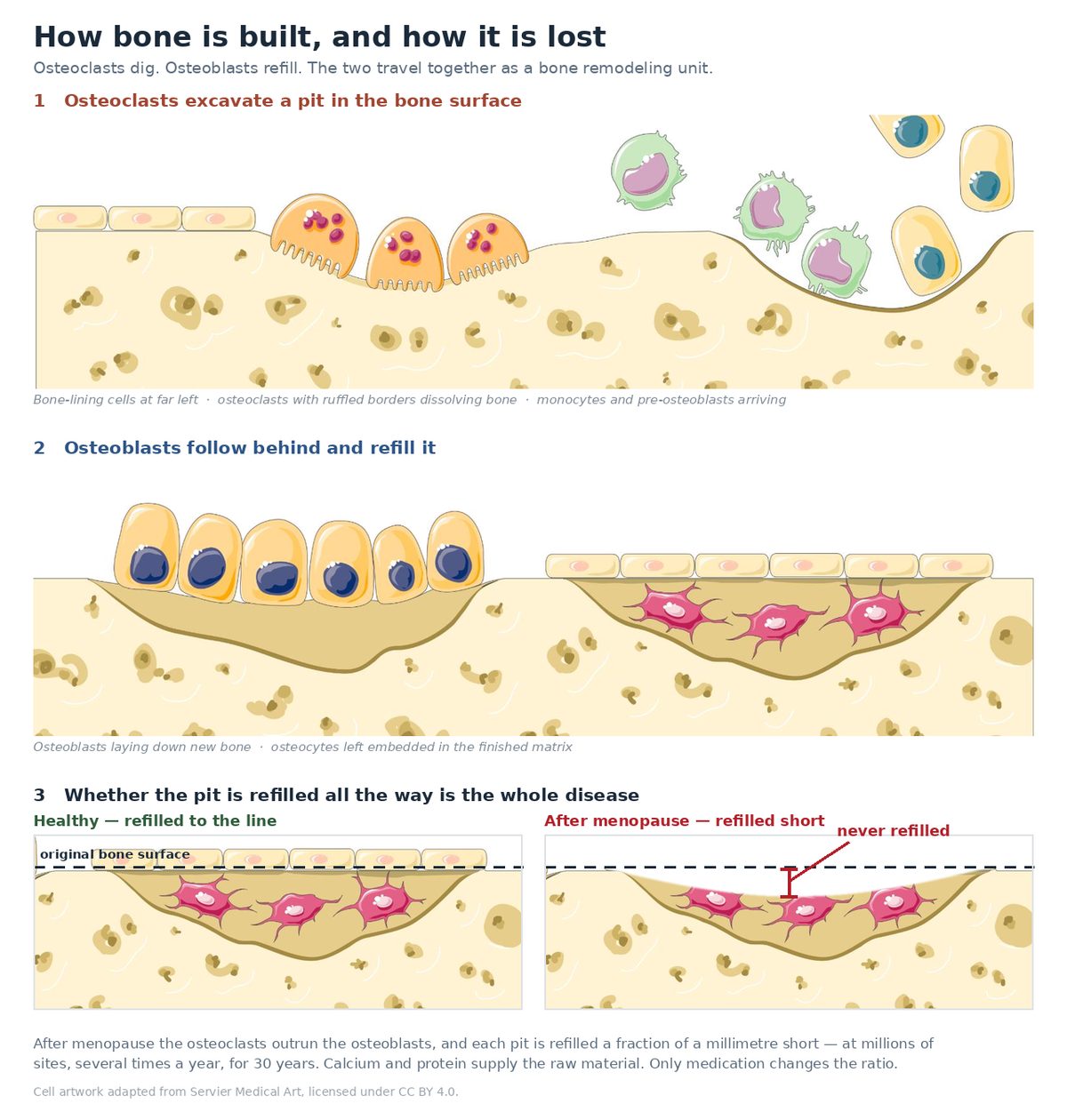
Now look at what a supplement can do about that. Calcium, vitamin D, protein, collagen, magnesium, boron – these are building blocks. Raw material. And raw material is genuinely necessary, because a crew with no bricks builds nothing. But delivering more bricks to a site where the demolition team is outpacing the builders does not change the ratio between them. What you get is a well-supplied deficit.
Only the medications change that ratio. The bone-protecting drugs slow the osteoclasts, so fewer and shallower pits are dug and the osteoblasts can keep up. The bone-building drugs drive the osteoblasts, so more goes back in than came out. Both act on the accounting itself. Nothing on a supplement shelf does.
That is the entire argument of this article in one paragraph, and it is why I will not tell a woman with a T-score of −3.0 that better nutrition is a plan.
How this is treated conventionally
There are two kinds of drug. Bone-protecting medicines slow the rate at which bone is taken apart: alendronate (Fosamax), risedronate (Actonel) and ibandronate (Boniva) as weekly or monthly pills, zoledronic acid (Reclast) as an annual infusion, denosumab (Prolia) as an injection every 6 months. These are the workhorses – mostly generic, cheap, decades of fracture data behind them.
One caveat on Boniva, because it is widely prescribed and the distinction rarely gets made: it is the only drug in that list never shown to reduce hip fractures. It works on the spine. If the hip is what worries you, and after 70 it should be, it is not the one I reach for.
Bone-building medicines add new bone rather than preserving what is left: teriparatide (Forteo) and abaloparatide (Tymlos) as daily injections, romosozumab (Evenity) monthly for 12 months. Each is a time-limited course that must be followed by a bone-protecting drug, because bone built and then left unguarded is lost again. For severe disease the sequence matters: build first, then lock it in.
One rule worth repeating: Prolia must never simply be stopped – if it comes off, something else takes over promptly, or the bone you gained comes off with it.
Estrogen belongs here, and it is the one thing patients think of as natural that has real randomized fracture data. In the Women’s Health Initiative – 16,608 postmenopausal women over a mean 5.6 years – hormone therapy cut total fractures by about a quarter. I will be careful about the hip: those numbers pointed the same way but did not reach statistical significance. A real effect overall, then, and a hip result that is suggestive rather than proven. For a woman who also has menopausal symptoms, that changes the calculus considerably.
In men, low testosterone is a genuine cause of bone loss, and replacing it improves bone density – but it has never been shown to prevent fractures. Holding those two facts at once is the whole discipline of this article.
What the supplement industry sells, graded honestly
Strontium is the one I feel strongest about. Strontium ranelate was a real prescription drug in Europe, sold as Protelos, restricted and then withdrawn over cardiovascular risk. It was never approved here. What is sold here is strontium citrate, a supplement never tested against fracture at all.
Then the part almost nobody is told. Strontium sits directly below calcium on the periodic table, atomic number 38 against calcium’s 20. It substitutes into bone mineral, and being much heavier it blocks X-rays far more effectively than the calcium it replaced – and a DXA measures how much X-ray gets absorbed. So your bone density reading goes up without more bone being there. There is a published literature on correcting DXA results for strontium content. A rising scan on strontium is an artifact until proven otherwise, and it is sold as proof the product works.
Vitamin K2 is the most defensible item on the shelf and still not treatment. Two different things are sold under the name: MK-4 at 45 mg is a pharmacologic dose used in Japan, while the MK-7 in most bottles is measured in micrograms. Small effects on bone markers, no convincing fracture reduction, a real warfarin interaction.
Boron rests on one metabolic-ward study from 1987 – blood and urine, not bone – still the citation on the label nearly 40 years later. No density trial, no fracture trial. Magnesium, collagen peptides, silicon and microcrystalline hydroxyapatite are the same story in different packaging: plausible mechanism, surrogate measurements, industry funding, no fracture data.
Prunes, of all things, have better human data than any of them: a 12-month randomized trial found 50 g a day preserved hip bone density. The dried fruit has more evidence behind it than strontium, boron and collagen combined, which tells you how low the bar is on that shelf.
None of these has been shown to prevent a fracture in a human being.
Why the warning labels frighten people out of treatment
The reason people refuse these drugs is almost never the evidence. It is the label – which lists every symptom anyone reported during a trial, including the ones people on a dummy pill reported just as often.
So here is the idea that unlocks the whole thing: when a symptom occurs at the same rate on the drug and on the placebo, the drug did not cause it. Not “probably didn’t.” In a large trial looking at a common symptom, two groups coming out identical is about as close to proof of absence as medicine offers. If alendronate really wrecked stomachs, a trial of thousands of women would have caught it – and stomach pain, nausea, indigestion and heartburn all came out the same on drug as placebo.
The same pattern runs through the famous fears. The bone cancer warning on Forteo and Tymlos came from rats given up to 60 times the human dose for most of their lives; the FDA removed it in 2020 and 2021 after two decades of human data. Jaw osteonecrosis, the risk that stops more patients than any other, is overwhelmingly described in cancer patients on 10 to 12 times the osteoporosis dose, usually alongside chemotherapy.
I got tired of having this conversation from memory, so I wrote it down: a handout that goes drug by drug and lists a side effect only where it actually exceeded placebo, and says so plainly when nothing did. I go through it with patients in the office, and you are welcome to a copy.
Now the foundation, which is not optional and is not sufficient
Here is the fact that settles the argument between the drug camp and the supplement camp. Every pivotal osteoporosis drug trial gave calcium and vitamin D to both groups. The 70% reduction in spine fractures on Reclast was measured on top of repletion, not instead of it – the floor of the trial, never the alternative to it.
Calcium: 1,000 to 1,200 mg a day total, food counted first, supplementing only the gap. In people who are not deficient, supplements alone have not been shown to reduce fractures. More is not better, and the stone risk is real.
Vitamin D: check the level and treat what you find rather than guessing at a dose. In VITAL, 25,871 generally replete adults took 2,000 IU a day for about 5 years with no fracture reduction at all. And megadosing is not merely useless – in 2,256 women over 70 given 500,000 IU once a year, both falls and fractures went up.
Protein: the idea that it leaches calcium from your bones is dead and should be buried louder. Aim for 1.0 to 1.2 g per kilogram of body weight per day – protein is the substrate for the collagen framework of bone and for the muscle that keeps you off the floor.
Exercise is the only item here that addresses the other half of the equation. A hip fractures when force exceeds strength. Everything else works on strength; exercise works on force, by keeping you off the ground.
And loading is safer than you have been told. In the LIFTMOR trial, 101 postmenopausal women with low bone mass lifted heavy – 5 sets of 5 above 85% of their one-repetition maximum – twice a week for 8 months. Spine density rose 2.9% against a 1.2% loss in the controls. The finding that matters is not the 2.9%. It is that the entire trial produced one minor back spasm: heavy resistance training was safe in 65-year-old women with osteoporosis, the precise opposite of what those women are told. Add balance work, and get the falls conversation right – vision, blood pressure on standing, and the sedatives.
The one thing weight loss is bad for
Medical weight loss is a good part of my week, and it improves nearly everything I measure: blood sugar, blood pressure, lipids, sleep apnea, joint pain, fatty liver. Bone density is the exception, and nobody mentions it at the start.
Losing weight costs bone, at the hip in particular, whatever the method. Sustained caloric restriction runs roughly 1 to 2% a year at spine and hip. Sleeve gastrectomy is far steeper – hip density down 7.6 to 9.2% at 2 years. GLP-1 medications are not exempt: semaglutide raised markers of bone breakdown and lowered measured density at spine and total hip.
Does that translate into fractures? Less clearly than you would expect – a 2026 analysis of 59,879 adults with type 2 diabetes found 15% fewer fractures on semaglutide than on other weight-loss drugs. Retrospective, so a hypothesis rather than a settled answer.
The mitigation is not in doubt and is already on this page: resistance training and enough protein while the weight comes off. In the trials, people who lifted lost meaningfully less hip bone than those who dieted alone or did cardio only. If you are on a GLP-1 and not lifting, that is the conversation to have.
Where this leaves you
Normal density and no risk factors: the foundation is the entire plan. Osteopenia: the foundation, plus a real look at FRAX and at the causes nobody checked. Osteoporosis, by the number or by a fracture: the foundation and a medication – and the foundation does not buy you a delay.
The most expensive mistake I see is a woman who spends 3 years on a bone-support stack watching her scan drift downward, and arrives at treatment 3 years older with 3 years less bone. She was not careless. She was told the careful thing was to wait.
That is worth working out before the next fall rather than after it.
Schedule a Consultation in Fairfield, CT
I am a board-certified endocrinologist with 23 years of clinical experience and a certified clinical densitometrist, fellowship-trained at Montefiore and Albert Einstein College of Medicine and trained at Mount Sinai, with training through the Institute for Functional Medicine. You can read more about my background and approach here.
A fracture deserves an endocrinologist, not a follow-up X-ray.
Restore Health LLC
501 Kings Highway East, Suite 103, Fairfield, CT 06825
(203) 760-5544
Book your consultation, see what to expect as a patient, browse the full blog archive, listen to the audio health guides, or see the areas I serve throughout Fairfield County and beyond.
Related reading: parathyroid disease and calcium disorders, low testosterone treatment, and why you can’t sleep.